Build trust. Set the bar. Watch them rise.
Schools where
trust is built.
Ten minutes a day for every teacher. A Monday-morning view for every principal. One District Lens across every campus.
- Built by a PK-8 school leader
- T-TESS and Rising Star aligned
- No student names reach the AI
Three numbers you already know. One answer to each.
55%
of educators plan to leave early
Burnout Watch sees the slide first.
$20k
to replace one teacher who leaves
A coaching move, one tap, this week.
$8B
a year in turnover, nationally
Calm rooms become a daily habit, not luck.
See your dashboard in action.
A two-minute walkthrough of what your school leaders see on Monday morning.
Every campus. One Monday morning.
Which schools need you this week, who is using it, and whether it is working. Your own numbers, and a play you can send to a principal.
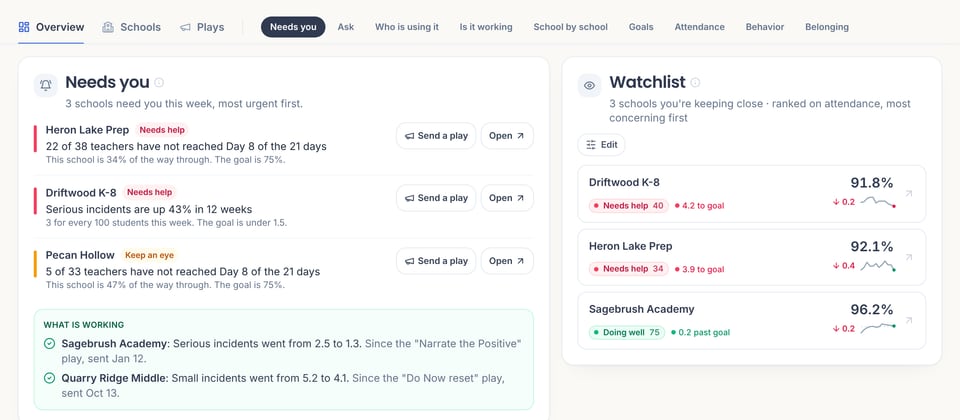
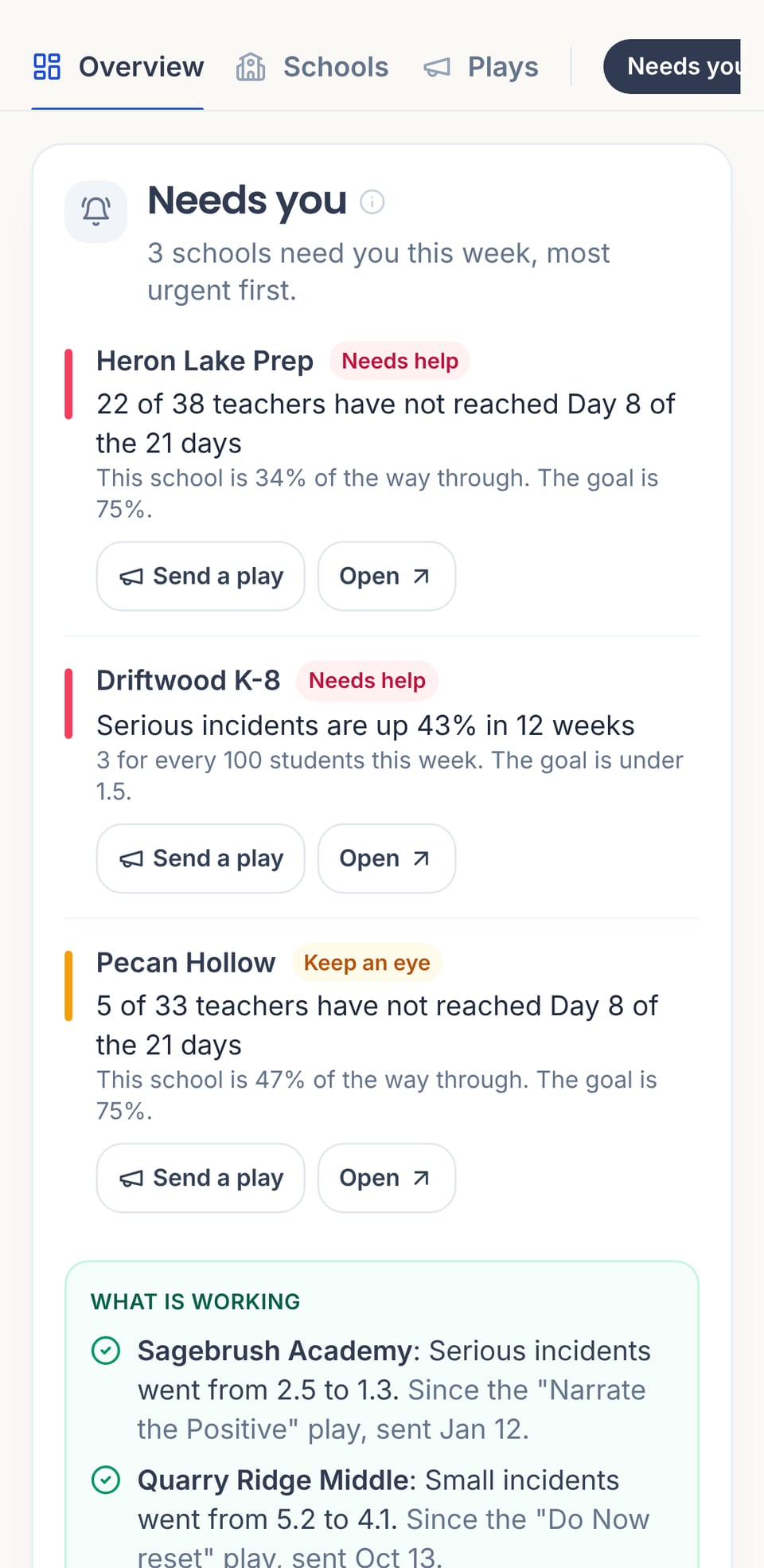
The schools that need you this week, first.
Sample data. Open the district demo and click around.
One classroom operating system. Three people it works for.
The 21-day playbook builds the habit. This keeps it. Tap anything.
Districts
Every campus, one view
District Lens. Who needs you. Who is using it. Is it working.
Principals & directors
Every week, at a glance
Needs attention. Alerts and coaching signals, one tap to act.
Teachers
Every day, ten minutes
Try a strategy. One tap. The platform asks later whether it helped.
Aligned to your state's teacher evaluation rubric.
Every day of teacher development maps to your state's official evaluation framework, so your teachers don't just improve their practice, they generate the evidence their appraiser is looking for.
Texas
Texas Teacher Evaluation & Support System
Every day of the K-8 playbook maps to a T-TESS dimension and descriptor. When a Texas teacher completes Day 1 ("Define Your Non-Negotiables"), they're producing appraiser-visible evidence for T-TESS Domain 3, automatically surfaced on their My Growth dashboard, the principal's readiness panel, and a downloadable Evidence Summary PDF for their evaluation portfolio.
T-TESS 3.1
Classroom Environment, Routines and Procedures
Days 1-3, 5, 8, 16, 20 produce documented evidence for procedures, routines, supplies management, and safety.
T-TESS 3.2
Managing Student Behavior
Days 4, 7, 12, 15, 17 generate evidence of "consistently and appropriately" applied behavior management.
T-TESS 3.3
Classroom Culture
Days 6, 9, 10, 11, 13, 14, 18, 19, 21 build evidence for "mutually respectful and collaborative" classroom climate at the Distinguished band.
Also live for early childhood: Texas Rising Star Category 2: Caregiver-Child Interactions. Every day of the EC playbook produces evidence for the five Category 2 subcategories. See For Centers for the full breakdown.
The business case, at a glance.
What turnover costs you now
$10,000 to $20,000 for every teacher who leaves
Months of recruiting while a sub covers the room
Instructional minutes lost to resets that never stick
Families and strong teachers who stop choosing you
What you get back
Burnout Watch flags a teacher before the resignation letter
A certification record for every teacher, skill by skill
Climate by campus and by week, not by rumor
Notes home and family replies, counted
What makes this different.
Built by a PK-8 school leader
Not a software vendor. A career inside the pipeline, from juvenile justice to Director of Culture & Safety across a Texas charter network, then the tool he needed.
Meet the founderEvidence by classroom and by child
Every strategy tried and how it went, following the child to every adult who teaches them. Your own benchmarks on the screen, never a prediction.
Private by design
Row-level security, an audit log, families' replies that stay with the school, and no student name ever sent to an AI.
How privacy worksThe questions a district office asks first.
Pilot size, what the district office sees, rubrics, data, scale, and price. Straight answers, in the order they usually come up.
How big is a pilot, and how fast is a campus live?
One to three campuses is the usual pilot. A campus is live the week its roster is in: staff get an email invite, students come in by CSV, and teachers open Day 1 the next morning. The 21 days run on the school calendar, so the first certification records and the first Monday-morning dashboard arrive within about five weeks. A district license has no per-campus seat cap, so growing the pilot is a licensing conversation, not a rebuild.
What does the district office actually get?
The District Lens: a Needs you list that names the schools that need attention this week; who is using the platform and whether it is working, school by school; sentences ready to share with your board; a question box that answers from your own numbers; attendance with the arithmetic shown; and your own achievement benchmarks (MAP, STAAR, i-Ready, entered per testing window and never predicted). You can send a play to a principal and watch it move from seen to assigned to acted, and see notes home and family replies counted by campus and week. The Learn tab shows your leaders the 21 days exactly as teachers see them, and gives them a path of their own: six short steps on leading culture across schools, each starting from your district's numbers and ending with something they do on the dashboard. The public demo runs on sample data, so you can open it right now.
What does a teacher do each day, and after Day 21?
Ten minutes: a short read, one move to try in the room that day, and a reflection. After Day 21 the platform keeps running the room with them: a Strategy Hub with 42 strategies, one tap to record what they tried, a note home already drafted in family words, a coach that answers in plain language with names removed before the question leaves the device, and a private journal no leader can read.
Which state evaluation rubrics are supported?
Texas T-TESS for K-8 is live today, and so are Texas Rising Star Category 2 and Michigan Early Childhood for early childhood. Tennessee TEAM, Florida FEAPs, California CSTP, and the Danielson Framework are the named next frameworks; a rubric is data, not code, so adding yours is a seed file, not a rebuild. The platform produces evidence of practice by dimension and a Day 21 Evidence Summary. It never assigns or predicts a rating; your appraisers do.
Where does our data live, and who can see what?
A school's data belongs to the school. It lives in a Postgres database with row-level security scoped to that school, and a person's role is enforced in the database, not in the browser. Teachers see their own students, principals see their campus, and district admins see the District Lens. Every note home is logged, families' replies stay with the school, and no student's name is ever sent to an AI. Feature flags per school (the family loop, the Wins Wall, share links) are the staged-rollout lever procurement asks about.
Will it hold up at our size?
It was measured, not assumed. A district's worth of data (12,000 students, 60,000 behavior logs, 40,000 playbook notes, and 600 staff across 20 campuses) was loaded into the live production database inside a transaction, queried as a real teacher and a real principal through row-level security, and rolled back. At that volume a school dashboard loads in under a millisecond and 90 days of Behavior Trends in about 50 milliseconds. The platform is not close to its ceiling.
How is it priced?
Per seat, per year: teacher seats start at $249 and administrator seats are $399.99, with custom pricing for multi-campus rollouts. A district license has no per-campus seat cap, and every seat includes the full dashboard, the strategy guides, and ongoing implementation support.
From a first conversation to every campus.
- 1
District assessment
Retention, climate, and the campuses to pilot.
- 2
Leadership alignment
Board and cabinet buy-in, and a timeline.
- 3
Pilot: one to three campuses
Rosters in, Day 1 the next morning, a dashboard in five weeks.
- 4
District-wide expansion
Scale the pilot and grow your own coaching bench.